If you’ve been researching ways to scale your team or reduce operating costs, you’ve almost certainly run into the terms offshoring vs. outsourcing — and probably “nearshore” too. These words get used interchangeably, but they mean very different things. Choosing the wrong model can cost you months of productivity, hidden fees, and serious collaboration headaches.
Outsourcing is the broadest of the three terms. It simply means hiring an external party — a vendor, agency, or third-party provider — to handle a business function that would otherwise be performed in-house.
Outsourcing is defined by what you’re doing: delegating work outside your organization. It says nothing about where the work happens. Your outsourced vendor could be across the street or across the world.
Offshoring refers specifically to relocating a business function or hiring talent in a country that is geographically far from your headquarters — typically to take advantage of significantly lower labor costs or a large talent pool.
When most people think of offshoring, they picture companies building engineering teams in India or the Philippines, or running back-office operations in Vietnam or Eastern Europe. The defining feature of offshoring is distance — both geographic and, often, cultural and temporal.
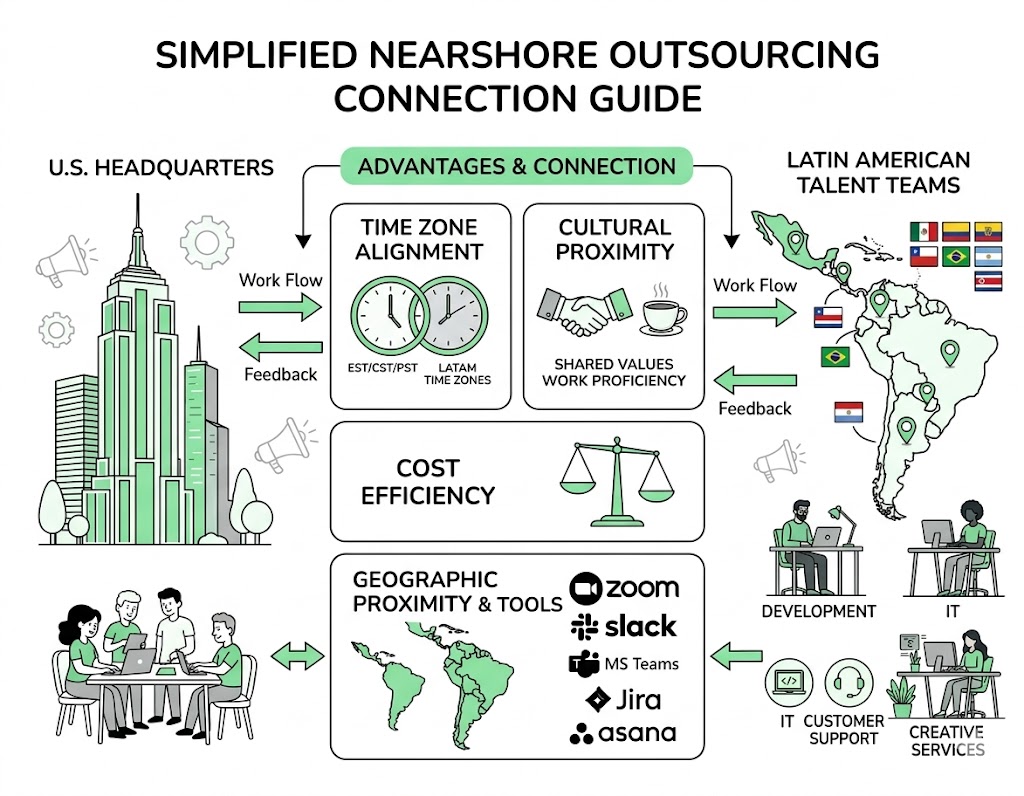
Nearshore is a specific form of offshoring — but with one crucial distinction: the talent or team is located in a neighboring or nearby country, within a similar or overlapping time zone.
For U.S. companies, nearshore typically means working with talent in Latin America — countries like Mexico, Colombia, Brazil, Argentina, Costa Rica, or Chile. For Western European companies, it often means Eastern Europe or North Africa.
The nearshore model combines the cost advantages of offshoring with the collaboration benefits of working in compatible time zones and, increasingly, shared cultural and business norms.
Still not sure? Check this out.
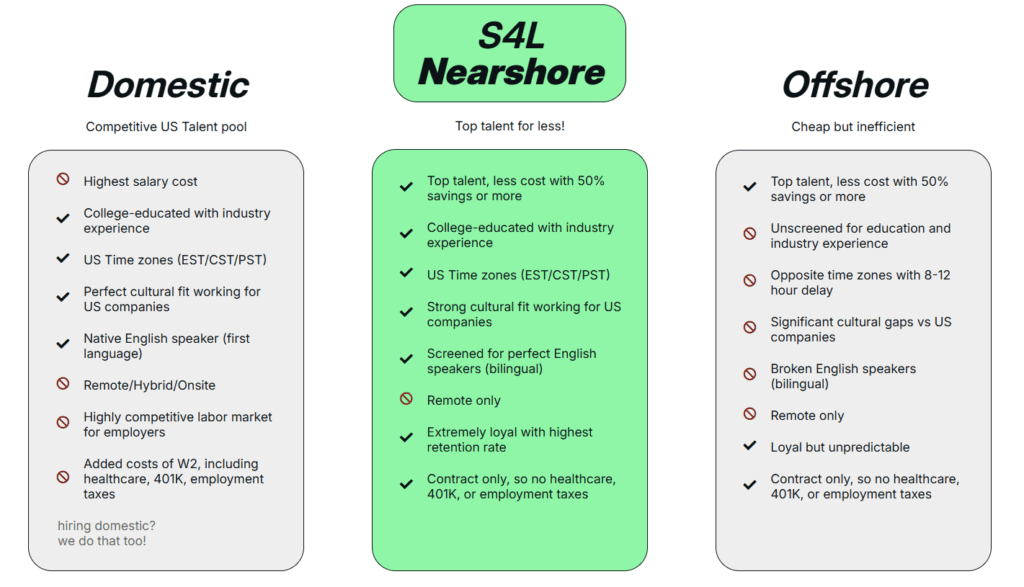
The right choice depends on your priorities. Here’s a simple framework:
For most U.S. technology and professional services companies today, nearshore outsourcing hits the ideal balance. It’s not the cheapest option on paper, but when you factor in the productivity loss from misaligned time zones, the hidden costs of offshore coordination overhead, and the value of a team that feels genuinely integrated — the math often favors nearshore.
The data is clear: nearshore adoption among North American companies has surged over the past five years. According to Deloitte’s Global Outsourcing Survey, organizations are increasingly prioritizing agility and collaboration capabilities over cost alone when selecting talent models.
Latin America, in particular, has emerged as a top nearshore destination for U.S. companies because of its rapidly growing tech talent pipeline, high English proficiency rates in major markets, and cultural alignment with North American business norms. Countries like Colombia, Mexico, and Argentina now produce hundreds of thousands of STEM graduates annually — and many are already working within U.S. company cultures.
The shift isn’t just about convenience. It’s about building teams that perform. And teams perform best when they can collaborate in real time, communicate without barriers, and share a working culture.
Is nearshore the same as outsourcing? Nearshore is a type of outsourcing, but not all outsourcing is nearshore. Nearshore specifically refers to engaging talent or teams in nearby countries within similar time zones, while outsourcing is a broader term for hiring any external party to perform a business function.
Is offshoring always cheaper than nearshore? Far-offshore markets (India, Philippines, Vietnam) typically have lower hourly rates than nearshore markets. However, total cost of offshoring often rises when you account for collaboration overhead, communication delays, and productivity loss from time zone gaps. Many companies find nearshore delivers a better ROI when these factors are included.
What’s the difference between nearshore and offshore? The key difference is distance and time zone. Offshore locations are geographically far — typically in Asia — with large time zone differences. Nearshore locations are geographically closer, typically within 0–3 hours of the client’s time zone, enabling real-time collaboration.
Can I outsource and also use nearshore at the same time? Absolutely. Many companies use a blended model — outsourcing certain project-based tasks while maintaining a nearshore team for ongoing, integrated development or operations work. The two approaches can complement each other within a broader talent strategy.
What roles work best for nearshore teams? Software engineering, product design, QA and testing, data analytics, finance and accounting, customer success operations, and digital marketing are all common nearshore functions for U.S. companies. Essentially any knowledge-work role that benefits from real-time collaboration is a good nearshore candidate.
Understanding the difference between offshoring, outsourcing, and nearshoring is the first step. The second is finding the right partner to execute.
Our nearshore outsourcing services are designed to help U.S. companies build fully integrated, high-performing teams in Latin America — with compliance, talent acquisition, and operational support handled end to end.
Explore our nearshore solutions →
Or get in touch with our team to discuss your specific hiring goals and timeline.
S4L Partners helps businesses find skilled domestic and nearshore professionals to scale operations and build a world-class team.