
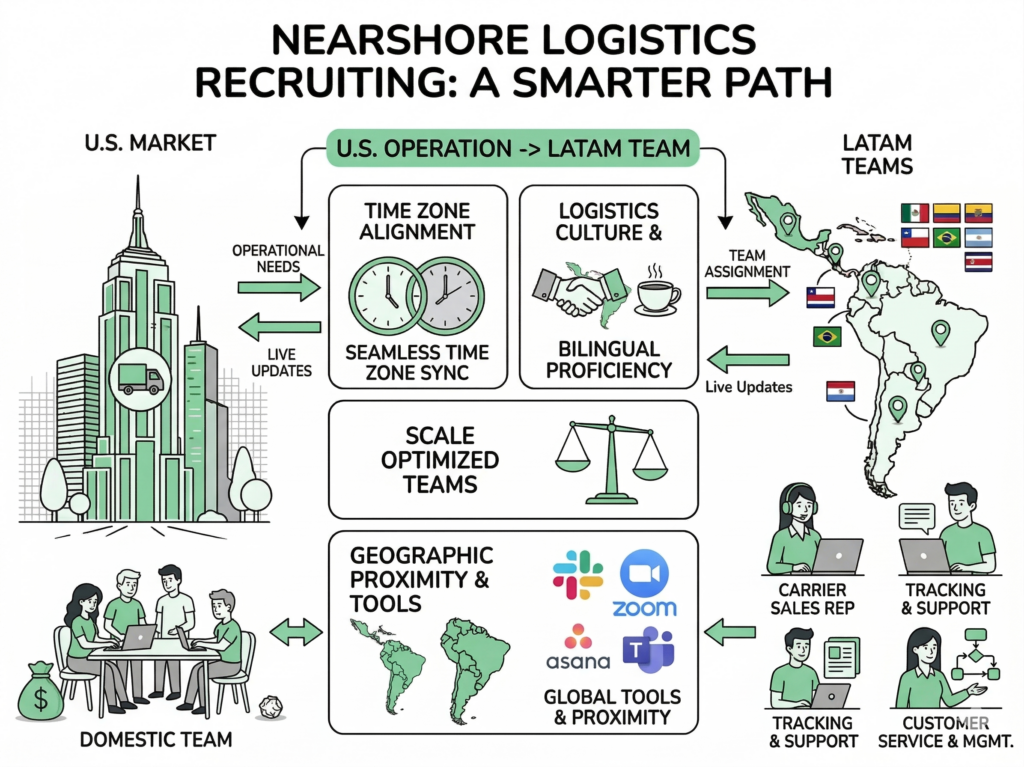
If you’re trying to hire a carrier sales rep right now, you already know the problem: the U.S. freight market is competitive, domestic salaries keep climbing, and turnover in carrier sales roles is brutally high. The average tenure of a carrier sales rep is under two years, meaning you’re often right back at square one before they’ve fully ramped.
There’s a smarter path. This guide breaks down what it actually costs to hire carrier sales talent domestically, why nearshore logistics recruitment has become the go-to alternative for scaling brokerages and 3PLs, and exactly what to look for when building your team.
Before you can hire the right person, you need to be precise about the role. A carrier sales rep is responsible for sourcing, negotiating with, and managing relationships with trucking carriers to move freight for brokers or shippers. In a freight brokerage environment, they are the engine of your supply chain execution.
Day-to-day, the role typically includes:
– Outbound carrier prospecting: cold calling and building relationships with new carriers
– Load-to-carrier matching: identifying available capacity on lanes where freight needs to move
– Rate negotiation: securing competitive spot and contract rates from carriers
– Shipment tracking and communication: ensuring pickups and deliveries happen on time
– Issue resolution: managing delays, claims, and service failures in real time
– TMS data entry and updates: keeping transportation management systems accurate
This is a high-volume, phone-heavy, process-driven role. It requires strong communication skills, resilience, attention to detail, and fluency in freight terminology, but it does not require geographic proximity to your customers or a U.S. zip code.
When most freight brokerages think about hiring costs, they think about
base salary. But the total cost of a U.S.-based carrier sales rep is
considerably higher once you account for all the components.
Cost Component | Estimated Annual Range (USD) | Expense Type |
Base Salary | $50,000 – $70,000 | Recurring |
Performance Bonus / Commissions | $8,000 – $20,000 | Recurring |
Employer Payroll Taxes (FICA, FUTA, SUTA) | $5,500 – $7,000 | Recurring |
Benefits Package (Health, Dental, Vision) | $6,000 – $12,000 | Recurring |
401(k) Matching | $1,500 – $3,500 | Recurring |
Recruiting & Agency Fees | $7,500 – $14,000 | One-time |
Onboarding & Training Cost | $2,000 – $5,000 | One-time |
Total Year-One Investment | $80,500 – $131,500 | Fully Burdened Cost |
And that’s before factoring in turnover. According to industry benchmarks from the Transportation Intermediaries Association (TIA), voluntary turnover in carrier sales roles runs between 25–35% annually. When a rep leaves after 18 months, you’re absorbing replacement costs on top of an already significant investment.
carrier sales, operations coordination, track-and-trace, load planning, suffers from a specific set of structural problems that make domestic hiring increasingly unsustainable for growing brokerages.
Every freight broker in your region is recruiting from the same local pool. Experienced carrier sales reps are scarce, and companies with bigger brand names or larger commission structures consistently outbid smaller operators.
Carrier sales is a grind. The most talented reps either get promoted into account management or jump to shipper-side jobs. The ones who stay often plateau. Hiring for this role domestically means accepting a near-constant churn cycle.
Since 2020, logistics wages have risen faster than freight revenue in many lanes. Brokerages operating on thin margins can’t keep pace with salary expectations without compressing their own profitability.
Nearshore logistics recruitment means hiring carrier sales reps and back-office talent from Latin American markets, countries like Colombia, Mexico, Argentina, and Costa Rica, that operate within 0–3 hours of U.S. time zones.
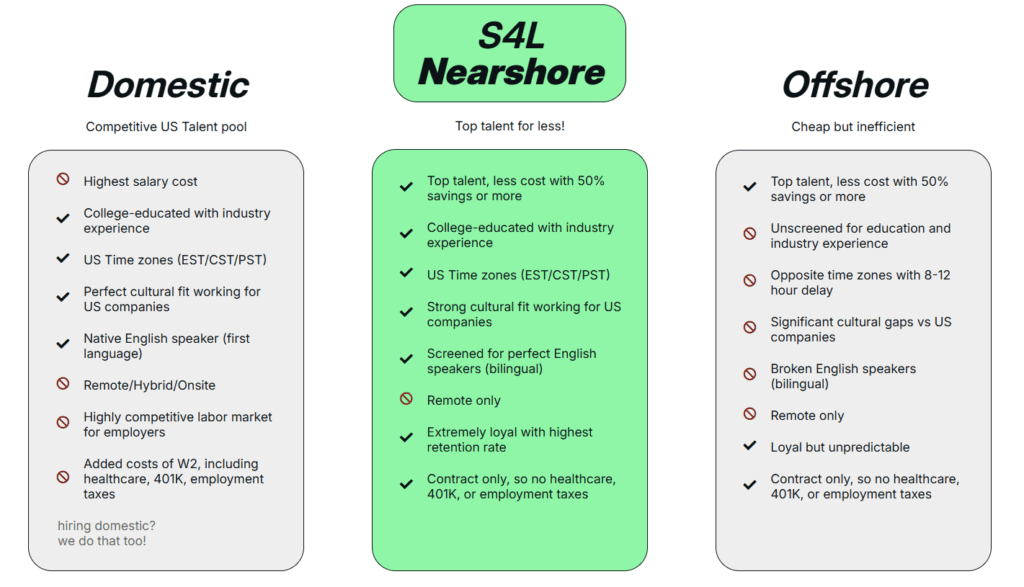
This model has fundamentally shifted the economics of freight brokerage operations for U.S. companies.
Carrier sales is not an asynchronous role. Reps need to answer the phone when a carrier calls, respond to rate requests in minutes, and track loads in real time. A team 12 hours ahead or behind simply can’t execute this. Nearshore talent in Bogotá, Medellín, Mexico City, or Buenos Aires overlaps entirely with U.S. operating hours.
Colombia, Argentina, and Costa Rica in particular have large populations of business-fluent English speakers, many of whom have worked directly with U.S. companies in tech, finance, and logistics.
As U.S. freight brokerages have expanded nearshore operations over the past five years, local professionals have gained real carrier sales experience. This is no longer a “train from scratch” situation, experienced nearshore carrier sales talent exists and is accessible.
A skilled carrier sales rep in Colombia or Mexico typically costs $18,000–$32,000 per year in total compensation, compared to $80,000–$131,000 for an equivalent U.S. hire. That’s a savings of $50,000–$100,000 per head, per year, without compromising on quality when the talent acquisition process is done correctly.
Not every candidate who applies for a nearshore carrier sales role will be the right fit. Here are the specific attributes to prioritize in your talent acquisition process:
– Business-level English fluency: spoken and written; test this rigorously in the interview process
– Prior experience in freight, logistics, or a high-volume call environment: the freight learning curve is steep; reduce ramp time by hiring people with relevant exposure
– TMS familiarity: experience with tools like McLeodSoftware, Turvo, Mercury Gate, or even basic TMS platforms signals operational readiness
– Comfort with U.S. business culture: directness, urgency, and responsiveness are non-negotiable in carrier sales
– Experience cold-calling in an English-speaking environment
– Knowledge of U.S. lane geography and major freight corridors
– Understanding of spot vs. contract rates and load boards (DAT, Truckstop)
– Candidates who have only worked in Spanish-language environments with no U.S.-facing exposure
– Lack of metrics or KPIs from previous roles (carrier sales is measurable, good reps know their numbers)
– No experience with high-volume, fast-turnaround communication
Factor | U.S. Domestic Hire | Nearshore Hire |
Base salary range | $50,000 – $70,000 | $24,000 – $30,000 |
Total year-one cost | $80,500 – $131,500 | $26,000 – $35,000 |
Time zone overlap | Full | Full (0–3 hrs) |
English fluency | Native | Business-level (varies by market) |
Freight experience available | Yes | Growing rapidly |
Avg. annual turnover rate | 25–35% | 10–18% (with proper onboarding) |
Ramp time | 60–90 days | 60–90 days (with structured training) |
Compliance complexity | Standard U.S. employment | Requires EOR or local entity |
The numbers make a compelling case on their own. But the deeper value is operational: a well-structured nearshore carrier sales team typically delivers lower turnover, better documentation habits, and stronger process adherence than domestic teams in the same role, because the talent acquisition and onboarding process selects for exactly those qualities
Write a job description that includes required TMS tools, expected call volume, lane knowledge, and English proficiency level. Vague descriptions attract vague candidates.
Colombia (Bogotá, Medellín) and Mexico (Monterrey, Guadalajara) are currently the strongest markets for English-proficient logistics professionals. Argentina (Buenos Aires) is also strong for analytics-heavy back-office roles.
General nearshore staffing firms don’t understand freight. The screening criteria for a carrier sales rep is different from a software engineer. Find a partner with logistics-specific experience who can assess freight knowledge, English proficiency in a freight context, and cultural fit for U.S. brokerage environments.
Even experienced nearshore reps will need TMS access, lane education, your carrier preference lists, and scripting for your specific brokerage model. Don’t skip this step, it’s what separates successful nearshore builds from failed ones.
Loads covered per day, carrier acquisition rate, on-time pickup and delivery percentage, rate accuracy. Nearshore teams should be held to identical performance standards as domestic hires, that’s what makes the model sustainable.
Explore our logistics recruitment services to learn how we build nearshore carrier sales teams for U.S. freight brokerages and 3PLs.
Yes, when hired and trained correctly. U.S. carriers care about responsiveness, rate accuracy, and reliability. A nearshore rep with strong English, freight experience, and proper training delivers on all three. Hundreds of U.S. freight brokerages now run their carrier sales operations primarily with nearshore teams.
Most nearshore logistics professionals in Latin America work standard U.S. business hours by default, many markets are in the same or adjacent time zones to U.S. Central and Eastern. Colombia is UTC-5 year-round, Mexico City is CST, and Argentina is UTC-3. All overlap fully with U.S. freight operating hours.
With the right talent acquisition partner, time-to-hire for a nearshore carrier sales rep is typically 3–6 weeks from brief to start date, faster than most domestic searches for the same role. A structured pipeline with pre-vetted candidates can reduce this to 2–3 weeks.
Not necessarily. Most U.S. companies use an Employer of Record (EOR) model, a local entity handles compliance, payroll, and benefits in the candidate’s country, while you manage the day-to-day work. This eliminates the need to establish a legal entity abroad and significantly reduces compliance risk.
Nearshore talent (Latin America) is typically priced 15–25% higher than far-offshore markets (India, Philippines). However, for real-time roles like carrier sales that require full U.S. time zone coverage, nearshore is the only model that actually works. The productivity difference more than offsets the cost premium.
The U.S. freight industry is overdue for a smarter approach to carrier sales talent acquisition. Domestic hiring costs are high, turnover is relentless, and the talent pool isn’t getting any deeper. Nearshore logistics recruitment changes that equation, delivering qualified, English-proficient carrier sales professionals who work your hours, use your tools, and ramp on a timeline comparable to domestic hires.
Whether you’re a freight brokerage looking to scale your carrier desk, a 3PL building out a back-office operations team, or a startup that needs to move fast without breaking your budget, nearshore is worth a serious look.
Explore our logistics recruitment services →
Or speak with our team about building your nearshore carrier sales operation from the ground up.
S4L Partners helps businesses find skilled domestic and nearshore professionals to scale operations and build a world-class team.