
If you’ve ever posted a “Logistics Customer Service Representative” job on Indeed and gotten flooded with résumés from retail call center candidates who’ve never heard of a Bill of Lading you already understand the problem.
This is one of the most misunderstood roles in freight. Companies treat it like a generic customer service position. They hire for soft skills and train for freight context later, which means a slow ramp, inconsistent shipper communication, and another open seat six months down the road when the candidate decides logistics isn’t for them.
The role deserves a smarter approach and a smarter hiring model. This guide breaks down what a Logistics Customer Service Representative actually does, what it genuinely costs to staff the position domestically, and why nearshore logistics customer service recruitment is the model growing brokerages and 3PLs are using to solve this problem for good.
A Logistics Customer Service Representative is the primary point of contact between a freight brokerage or 3PL and its shipper clients. While the Customer Operations Coordinator focuses inward on load execution, the Customer Service Rep faces outward managing the shipper relationship and ensuring they feel informed, confident, and heard throughout every shipment.
Answering calls and emails from shipper clients about load status, delays, pricing, and service issues
Reaching out before shippers ask, with accurate ETAs, exception notifications, and resolution timelines
Gathering load details from shippers, coordinating with carrier sales for capacity, and confirming rates in writing
Documenting freight damage, shortages, or service failures and liaising between the shipper, carrier, and internal ops team
Entering new loads into the transportation management system accurately and maintaining shipment records
Acting as the day-to-day voice of the brokerage for assigned shipper accounts, building trust through consistent, professional communication
Monitoring on-time performance and service metrics for key accounts and flagging issues before they escalate
This is a relationship role with operational depth. It requires freight fluency, professional English communication, and the ability to remain calm and solutions-oriented when a load is two hours late and the shipper is calling for the third time. None of those skills are geography-dependent.
According to the Council of Supply Chain Management Professionals (CSCMP), customer service is one of the foundational pillars of logistics performance directly impacting shipper retention, repeat business, and brokerage reputation. Hiring wrong for this role doesn’t just cost you a salary. It costs you accounts.
The baseline salary for a Logistics Customer Service Representative sits in a deceptively manageable range, until you add everything else.
Cost Component | Estimated Annual Cost |
Base salary | $42,000 – $58,000 |
Performance bonus | $2,000 – $5,000 |
Employer payroll taxes (FICA, FUTA) | ~$3,800 – $5,500 |
Health, dental, vision benefits | $6,000 – $12,000 |
401(k) match | $1,260 – $2,900 |
Recruiting / agency fee (if applicable) | $6,300 – $11,600 (one-time) |
Onboarding and training | $2,000 – $4,500 |
Total Year-One Cost | $63,360 – $99,500 |
And this math only holds if the hire stays. The Society for Human Resource Management (SHRM) estimates the average cost to replace an employee at 50–200% of their annual salary. For a logistics CSR who leaves after 10 months before they’ve fully ramped on your accounts you’re absorbing replacement recruiting costs, lost institutional knowledge, and the service disruption that comes with putting a new face on your shipper relationships.
The domestic model for this role has a structural leak. The question isn’t whether it’s expensive, it’s whether you keep paying that cost indefinitely, or fix it.
The Logistics Customer Service Representative role has a specific hiring problem that’s different from other logistics positions: most companies are looking for it in the wrong candidate pool.
Here’s where domestic logistics customer service recruitment consistently breaks down:
Post a “Customer Service Rep – Logistics” job and you’ll attract candidates from retail, hospitality, insurance, and SaaS support backgrounds. They may have excellent phone skills and a friendly manner, but they don’t know what a BOL is, can’t read a rate confirmation, and have never handled a freight claim. Ramp time stretches to 90–120 days. Half of them decide freight is too stressful and leave.
Experienced logistics CSRs people who’ve worked at brokerages or 3PLs and genuinely understand the operational environment know their market value. They’re not entering at $45,000. They’re asking for $58,000–$68,000 base, and they have the offers to back it up. For a growing brokerage trying to staff two or three of these roles simultaneously, that salary reality compresses margins fast.
The best domestic logistics CSRs are often using the role as a launchpad into account management, pricing, or operations leadership. You invest in training them on your shipper accounts, your TMS, your escalation protocols and then they’re promoted, or they leave for a better title elsewhere. Gallup’s research on employee engagement consistently shows that roles perceived as entry-level or transitional have the lowest retention rates regardless of compensation and logistics CSR fits that profile exactly in domestic markets.
Shippers don’t operate on a 9–5 schedule. Freight picks up early and delivers late. Customer service calls come in before 8 AM and after 6 PM. Staffing domestic CSRs to cover those windows means shift premiums or burned-out employees who start missing calls at the edges of their shift.
Nearshore logistics customer service recruitment placing trained CSRs in Latin American markets within 0–3 hours of U.S. time zones resolves every friction point above simultaneously.
Here’s why the model works specifically for the Customer Service Representative role:
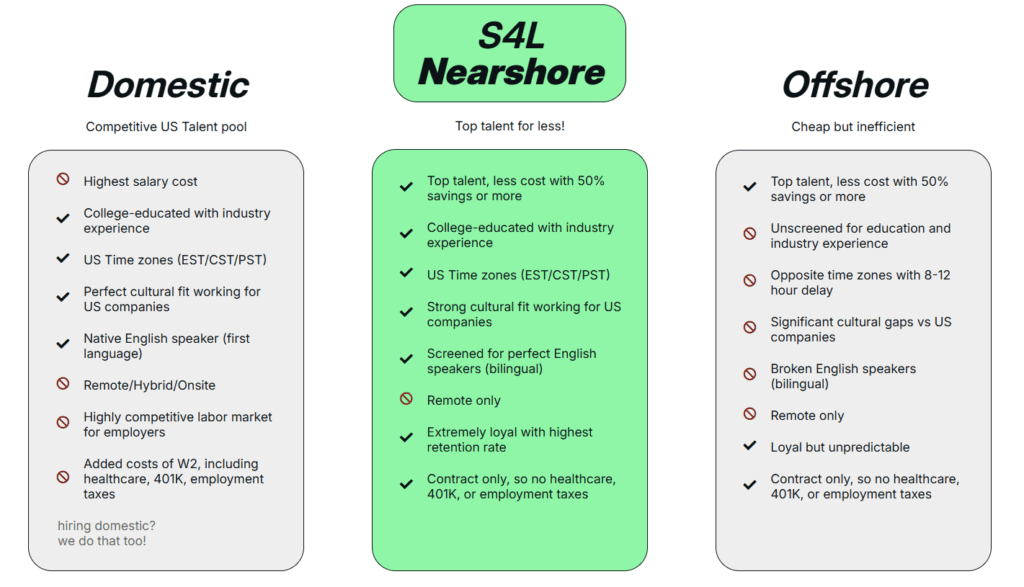
As U.S. freight brokerages have expanded nearshore operations over the past decade, a deep bench of Latin American professionals has gained real logistics customer service experience. These candidates already know what a rate confirmation looks like, how to handle a shipper who’s angry about a late delivery, and how to navigate a claims conversation professionally.
Colombia, Argentina, and Costa Rica consistently produce business-fluent English speakers with U.S.-facing communication experience. Per EF’s English Proficiency Index, several Latin American markets rank in the moderate-to-high proficiency band and within logistics-specific talent pipelines, candidates are screened for professional freight communication, not just general fluency.
A CSR in Bogotá starting at 7 AM COT is online when your first shipper calls at 7 AM EST. There is no delay, no async queue, no “we’ll get back to you first thing tomorrow.” The coverage is real and the responsiveness matches what your shippers expect.
A skilled nearshore Logistics Customer Service Representative typically costs $13,000–$24,000 per year in total compensation compared to $63,360–$99,500 for an equivalent U.S. hire. That’s $40,000–$75,000 in savings per seat, per year.
Nearshore professionals in logistics CSR roles are not using the position as a stepping stone to something else in your domestic org chart. With proper onboarding and a clear career path within your nearshore model, these roles hold significantly longer than their domestic equivalents.
For a deeper look at how nearshore compares to offshore and traditional outsourcing models, see our guide on offshoring vs. outsourcing vs. nearshore.
The numbers behind this model aren’t hypothetical. Bronco Transportation Services LLC has operated a nearshore logistics support model with S4L Partners for over 8 years and the outcomes are documented.
Metric | Industry Average | Bronco + S4L Partners |
Annual Savings | — | $500,000+ |
Recruitment Cost Reduction | Baseline | 40% – 50% |
Time-to-Fill Positions | 3 – 4 Weeks | 2 weeks |
Partnership Longevity | High Turnover | 8+ Years |
The founder of Bronco Transportation said it directly:
“Bronco has leveraged nearshore carrier sales support for about 8 years, and it’s been a strategic advantage for us. Consistently delivering high-caliber talent while keeping load payout margins meaningfully lower than a traditional U.S. broker model. In today’s market where costs continue to rise and broker margins have tightened significantly, this model really works. It’s allowed us to stay competitive without sacrificing service or execution. On carrier sales alone, we’re seeing roughly $500K in annual savings.“
— Founder, Bronco Transportation
The same infrastructure pre-vetted talent pipeline, logistics-specific screening, rapid time-to-fill that delivers carrier sales results for Bronco applies directly to the Customer Service Representative role. For brokerages that have already built confidence in nearshore on their operations desk, the CSR seat is the natural next step.

The screening criteria for this role is different from a generic CSR hire. These are the attributes that separate a productive nearshore logistics CSR from a frustrating one.
This role is your shipper’s primary point of contact. Written and spoken communication must be clear, professional, and freight-appropriate. Test with a logistics-specific scenario, not a general conversation
BOL, POD, rate confirmation, accessorial charges, freight claims. Candidates should know these without a glossary
Any exposure to McLeod, Turvo, MercuryGate, or similar platforms reduces onboarding friction significantly
The ability to manage 30+ active shipper inquiries per day without losing professionalism or accuracy
The CSR and the Customer Operations Coordinator are distinct roles. The CSR owns the shipper relationship. The Coordinator owns load execution. Conflating them in a job description produces candidates who are weak at both.
List the shipper communication volume expected, TMS tools required, claims handling expectations, and whether the role is assigned to specific accounts or handles inbound volume generally. Generic descriptions attract generic candidates.
A general nearshore provider screens for customer service aptitude. A logistics-specialized firm screens for freight fluency, U.S. brokerage familiarity, and the communication style that works in your specific shipper environment. The difference in candidate quality is significant.
Your nearshore CSR needs to know your top ten accounts, who they are, what they ship, how they prefer to communicate, and what their service level expectations are. Document this. The ramp time for a nearshore CSR with proper account onboarding is 30–45 days. Without it, it stretches to 90+.
First response time. Resolution time. Shipper satisfaction scores. Escalation rate. Hold nearshore CSRs to identical standards as domestic hires, that’s what makes the model credible internally and sustainable long-term.
Explore our logistics back-office recruitment services to see how we source and place Logistics Customer Service Representatives for U.S. freight brokerages and 3PLs.
The CSR owns the outward shipper relationship communication, updates, claims, and account management. The Customer Operations Coordinator owns inward load execution check calls, Macropoint monitoring, detention documentation, and TMS accuracy. Both roles are critical; they work parallel to each other, not interchangeably.
Yes, when screened and trained correctly. Claims handling requires freight terminology knowledge, documentation discipline, and calm professional communication under pressure. Nearshore candidates sourced through logistics-specific pipelines are screened for exactly these attributes. Proper onboarding that covers your claims process and escalation protocols closes the remaining gap.
Logistics customer service is widely perceived as an entry-level stepping stone in domestic markets. Candidates use it to build freight knowledge before moving into account management or pricing roles. According to Gallup research, transitional roles have structurally lower retention regardless of compensation. Nearshore professionals in the same role don’t have the same domestic career escalator making them significantly more likely to stay and grow within your model.
With a logistics-specialized partner and a pre-vetted pipeline, time-to-fill for a nearshore Logistics Customer Service Representative runs 2–3 days from confirmed role brief to shortlisted candidates compared to 3–4 weeks for equivalent domestic searches. Bronco Transportation achieved this timeline consistently across an 8-year engagement with S4L Partners.
Colombia (Bogotá, Medellín) and Costa Rica are the strongest markets for English-proficient logistics customer service professionals. Both have large populations with U.S.-facing communication experience and growing logistics-specific talent pipelines. Argentina (Buenos Aires) is strong for roles requiring more complex written communication or account management depth.
The Logistics Customer Service Representative is one of the most overlooked nearshore opportunities in freight. The role is shipper-facing, relationship-driven, and critically important but it’s also process-based, trainable, and completely executable by a nearshore professional who works your hours, speaks your language, and understands your freight environment.
Bronco Transportation’s $500K in annual nearshore savings didn’t happen by accident. It happened because they stopped treating logistics back-office roles as domestic-only hires and started treating them as a strategic talent decision. The CSR seat is the same opportunity.
Explore our logistics recruitment services →
Or speak with our team about placing your first nearshore Logistics Customer Service Representative in days, not weeks.
S4L Partners helps businesses find skilled domestic and nearshore professionals to scale operations and build a world-class team.