
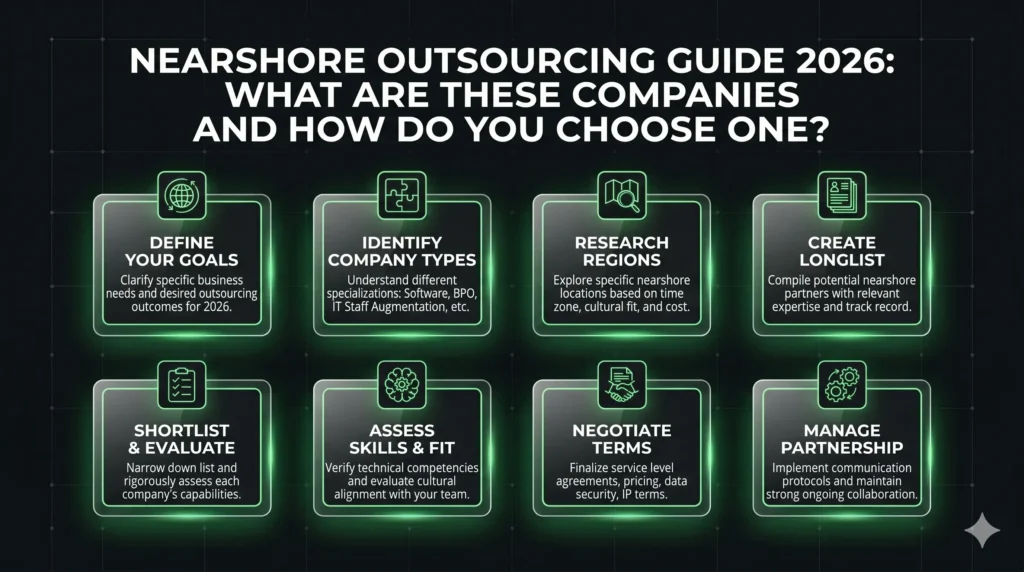
Nearshore Outsourcing Companies are service providers that help U.S. businesses hire or delegate work to talent in nearby countries typically Latin America within 0–3 hours of U.S. time zones. They handle talent acquisition, compliance, onboarding, and operations so you don’t have to build it yourself.
Nearshore outsourcing is the practice of hiring external talent or delegating business processes to companies or professionals in a neighboring or geographically close country specifically one that shares or closely overlaps your time zone.
For U.S.-based companies, nearshore outsourcing almost always means Latin America: countries like Colombia, Mexico, Argentina, Costa Rica, and Brazil. These markets sit within 0–3 hours of U.S. Eastern and Central time, making real-time collaboration, Agile workflows, and daily standups fully functional.
According to Deloitte’s Global Outsourcing Survey, agility and access to talent have overtaken cost as the primary drivers for outsourcing decisions a shift that directly favors the nearshore model over traditional far-offshore alternatives.
Nearshore outsourcing is not a new concept, but its adoption among U.S. small and mid-market companies has accelerated sharply since 2020, driven by remote work normalization and a growing technical talent pipeline across Latin America.
For a broader breakdown of how this model compares to alternatives, see our guide to offshoring vs. outsourcing vs. nearshore.
These companies are not simply talent marketplaces. The best nearshore outsourcing companies provide:
Sourcing, screening, and matching professionals to your role and culture
Handling local employment contracts, payroll, taxes, and benefits so you don’t need a legal entity abroad
Helping nearshore hires ramp within your tools, processes, and team culture
Acting as a bridge between your team and the nearshore talent to resolve issues and maintain performance
The range of what a “nearshore outsourcing company” covers is broad. Some focus exclusively on software engineering. Others specialize in business process outsourcing (BPO) functions like customer support, finance, or data entry.
A growing number including providers serving logistics, healthcare, and professional services offer role-specific talent acquisition pipelines tailored to industry-specific needs.
These three models are frequently confused. Here’s how they differ:
Model | Location | Time Zone | Best For |
Nearshore outsourcing | Neighboring country (e.g., Latin America for U.S.) | 0–3 hrs difference | Integrated teams, real-time collaboration |
Offshore outsourcing | Distant country (e.g., India, Philippines) | 8–13 hrs difference | Async tasks, high-volume, cost-driven work |
Business process outsourcing (BPO) | Anywhere | Varies | Delegating entire functions (e.g., customer service, payroll) |
The key distinction between nearshore and BPO is how the work is managed. With BPO, you hand off an entire function to a vendor who owns delivery. With nearshore outsourcing, you’re typically extending your team the talent works within your workflows, not separately from them.
According to Grand View Research, the global BPO market is projected to exceed $525 billion by 2030, and nearshore models are capturing an increasing share of that growth as companies prioritize collaboration over pure cost reduction.
For a deeper breakdown of these models, read our full comparison: Offshoring vs. Outsourcing vs. Nearshore: What’s the Difference?
Not all nearshore outsourcing companies operate the same way. Understanding the four primary models helps you identify which type matches your actual need.
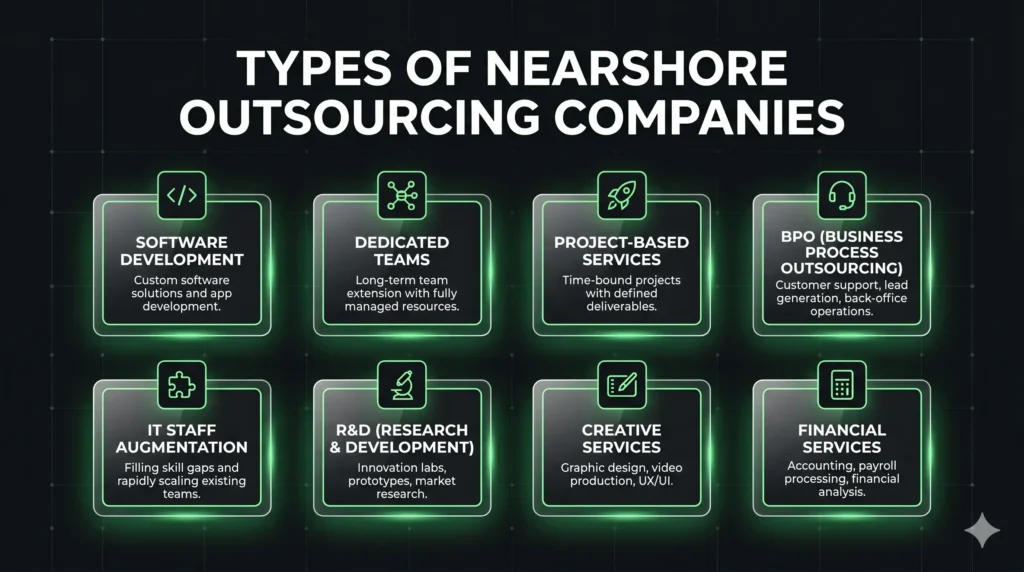
Staff augmentation companies place individual professionals developers, designers, analysts, operations specialists directly into your team. The talent works for you day-to-day, under your management and within your tools. The provider handles compliance, payroll, and HR.
Best for: Companies that want to extend their existing team with specific skills, maintain direct management control, and avoid building local HR infrastructure.
Examples of roles filled: Software engineers, QA testers, data analysts, carrier sales reps, back-office coordinators.
Managed service providers take on a defined scope of work and deliver results, not just headcount. You agree on outcomes, SLAs, and KPIs; the provider handles recruitment, team management, and delivery.
Best for: Companies that want to delegate a function entirely (e.g., customer support, payroll processing, IT helpdesk) and don’t want to manage the team themselves.
What to watch for: Ensure SLAs include quality metrics, not just availability. Gartner’s research on outsourcing management services consistently highlights that poorly defined SLAs are the leading cause of managed service disappointment.
These providers build and manage an entire dedicated team in a specific market often housed in a physical nearshore office that operates exclusively for your company. Think of it as a satellite office you don’t have to set up yourself.
Best for: Mid-market to enterprise companies that want scale, cultural alignment, and a long-term operational presence in a nearshore market without the overhead of establishing a foreign subsidiary.
A growing category: providers that specialize in a single vertical logistics, healthcare, fintech, legal services and build talent pipelines specifically for that industry’s needs.
Best for: Companies in specialized industries where generic sourcing fails because domain knowledge matters. A logistics company hiring carrier sales reps, for example, needs a partner that screens for freight knowledge, load board familiarity, and U.S. carrier communication skills not just general English proficiency.
Our nearshore outsourcing services are built around this model industry-specific talent acquisition with logistics, operations, and professional services pipelines already in place.
Latin America has emerged as the dominant nearshore region for U.S. companies. Here are the leading markets and what makes each one distinct:
Colombia particularly Bogotá and Medellín has become one of the fastest-growing nearshore hubs in the Americas. According to Coursera’s Global Skills Report, Colombia ranks among the top countries in Latin America for technology skill proficiency. Strong English programs, a young workforce, and UTC-5 time zone (same as U.S. Eastern year-round) make it a top-tier choice for software, operations, and logistics roles.
Mexico offers the largest nearshore talent pool in the region, with over 450,000 STEM graduates annually. The country shares a border and in many cities, the same time zone with the United States. Monterrey and Guadalajara are the primary tech hubs. Cultural proximity and deep integration with U.S. supply chains make Mexico particularly strong for logistics and manufacturing back-office roles.
Argentina produces some of the highest-quality engineering and analytics talent in Latin America. Buenos Aires has a strong tradition of technical education, high English proficiency among professionals, and a timezone (UTC-3) that works well for East Coast U.S. companies. Argentina is particularly competitive for data science, finance, and product design roles.
Costa Rica has long been a nearshore destination for U.S. Fortune 500 companies Intel, Amazon, and Procter & Gamble all have operations there. It offers political stability, high English proficiency, and Central Time Zone alignment. The talent pool is smaller than Colombia or Mexico but deep in quality.
Brazil’s size translates to scale: São Paulo and Rio de Janeiro offer massive talent pools for software engineering and customer operations. The primary challenge is language Portuguese, not Spanish but English proficiency is growing rapidly among Brazil’s tech workforce
Choosing the right nearshore outsourcing partner is one of the most consequential vendor decisions a growing U.S. company will make. Here’s a structured framework for evaluating providers:
– Hire individual contributors to work within your team (staff augmentation)?
– Delegate an entire function like customer support or payroll (BPO)?
– Build a dedicated team for a long-term initiative?
The answer determines which type of provider you need and which markets are most appropriate.
Ask every provider you evaluate: “What percentage of your placements are in [your industry]?”
A provider that places software engineers across 15 industries has different screening capabilities than one that specializes in logistics or healthcare. For roles that require domain knowledge carrier sales, clinical coordinators, financial analysts specialization matters enormously.
The quality of a nearshore provider’s output is only as strong as its talent acquisition process. Ask:
– How do you screen for English proficiency? (General test vs. role-specific assessment)
– What is your average time-to-fill for a role like mine?
– What percentage of your placements are still active after 12 months?
– How many candidates do you present per role?
Strong providers will have concrete, quantitative answers to all four questions.
How the provider handles employment compliance in the nearshore country matters for your legal exposure. The two main structures are:
– Employer of Record (EOR): The provider employs the talent locally, handling payroll, taxes, and benefits. You direct the work. Lower risk, faster to start.
– Contractor model: The talent is engaged as an independent contractor. Lower cost, but higher misclassification risk depending on the country.
For ongoing, full-time roles, the EOR model is generally recommended. The Society for Human Resource Management (SHRM) provides detailed guidance on international employment compliance considerations for U.S. companies.
Ask for 2–3 client references from companies in your industry, of similar size, with similar role types. A nearshore provider that serves enterprise software companies may not have the right infrastructure for a mid-size freight brokerage. Reference calls should specifically cover: time-to-fill, quality of candidates, and responsiveness when problems arise.
The best nearshore outsourcing companies will offer a pilot engagement one or two roles before asking for a long-term contract. A pilot lets you test the talent acquisition process, the caliber of candidates, and the provider’s responsiveness before you’re locked in.
Cost varies significantly by market, role type, and provider model. Here are realistic 2026 benchmarks:
Role Type | U.S. Domestic Cost | Nearshore Cost (Latam) | Typical Savings |
Carrier Sales Rep | $65,000–$90,000/yr | $24,000–$30,000/yr | 63–67% |
Customer Service Rep | $45,000–$60,000/yr | $24,000–$30,000/yr | 46–50% |
Recruiter | $55,000–$75,000/yr | $24,000–$30,000/yr | 45–60% |
Project Manager | $95,000–$125,000/yr | $24,000–$30,000/yr | 74–76% |
VA (Virtual Assistant) | $35,000–$50,000/yr | $24,000–$30,000/yr | 31–40% |
Note: Costs above represent total compensation including employer costs. Provider fees (EOR, management) typically add 15–25% above base compensation.
Beyond salary, total cost of engagement typically includes:
One-time placement fee (often 8–15% of first-year compensation)
or included in a monthly management fee.
Often included by quality providers
For a deeper look at carrier sales rep hiring costs specifically, see our guide on how to hire a carrier sales rep without overpaying.
Not every nearshore provider delivers what it promises. Watch for these warning signs:
Nearshore outsourcing means hiring talent or delegating business functions to professionals in a nearby country that shares your time zone. For U.S. companies, this typically means Latin America countries like Colombia, Mexico, or Argentina – here workers operate during U.S. business hours, enabling real-time collaboration at significantly lower cost than domestic hiring.
Nearshore outsourcing companies fill a wide range of roles: software engineers, QA testers, data analysts, customer service representatives, carrier sales reps, back-office coordinators, marketing specialists, finance and accounting professionals, and more. Any knowledge-work role that can be performed remotely and benefits from real-time collaboration is a strong nearshore candidate.
BPO means delegating an entire business function to a third-party vendor who owns delivery. Nearshore outsourcing typically means extending your own team with talent that works inside your workflows, under your management. The key difference is control: with BPO, you buy outcomes; with nearshore team extension, you manage the people directly.
Most quality nearshore outsourcing companies deliver shortlisted candidates within 5–10 business days of a confirmed role brief. Time from offer to start date typically adds another 1–3 weeks depending on EOR setup and onboarding requirements.
No. Nearshore outsourcing is highly accessible for small and mid-market businesses and the cost savings are often proportionally more impactful at smaller scale. Many nearshore providers specialize in growth-stage companies that need to build teams quickly and cost-effectively without the overhead of a traditional enterprise outsourcing contract.
For U.S. companies, the top nearshore markets in 2026 are Colombia, Mexico, Argentina, Costa Rica, and Brazil. Colombia and Mexico offer the deepest talent pools across the broadest range of roles. Argentina leads in engineering and analytics quality. Costa Rica is strong for enterprise-grade quality in a smaller market.
The nearshore outsourcing landscape in 2026 is more developed and more accessible than it’s ever been. Whether you’re exploring the model for the first time or evaluating your current provider against better alternatives, the framework in this guide gives you the criteria to make a confident decision.
If you’re looking for a nearshore partner that combines industry-specific talent acquisition, EOR compliance infrastructure, and a proven track record with U.S. logistics and operations teams, we’d like to be on your shortlist.
Explore our nearshore outsourcing services →
Or speak with our team to discuss your open roles and what a nearshore talent acquisition engagement looks like in practice.
S4L Partners helps businesses find skilled domestic and nearshore professionals to scale operations and build a world-class team.